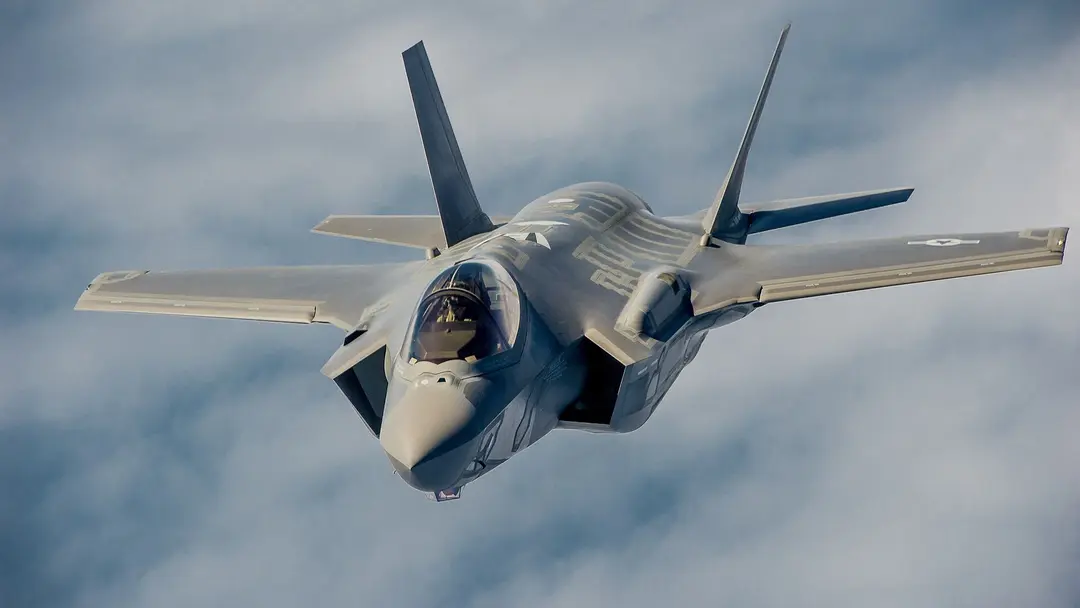
Lockheed flight-tests F-35 fighter with AI to help pilots identify threats faster
Aerospace giant Lockheed Martin has announced it has flight-tested a new artificial intelligence feature on its F-35 Lightning fighter.
The AI system identifies unknown contacts, providing the fighter pilot with rapid identification, Lockheed revealed in a statement.
According to the company, the new system, called Project Overwatch, will improve situational awareness and enhance pilot decision-making. It will also enhance the F-35’s software capabilities, bringing them in line with those of next-generation warfighters.

Project Overwatch: The F-35’s new AI system
The F-35 is a stealth fighter capable of engaging adversaries at a distance, even if they are too far away for the pilot to see with the naked eye. As such, F-35 pilots rely heavily on advanced software to identify and engage their targets.
The new AI system is designed to help pilots rapidly understand threats in their combat zone. This allows them to make decisions faster, as operators simply don’t have the time to synthesize data while in combat.
The defense firm developed the Project Overwatch system using its own Internal Research And Development (IRAD) funding, rather than as part of a specific Air Force contract, according to a Breaking Defense report.
The AI system test flight took place at Nellis Air Force Base in Nevada. According to Lockheed’s statement, “the successful demonstration … marks the first time a tactical AI model has been used in flight to generate an independent Combat ID on the pilot’s display.”
During the test, “a Lockheed Martin-built and trained AI/machine learning model resolved ID ambiguities among emitters, improving situational awareness and reducing pilot decision-making latency,” the company continued. In this context, emitters refer to radio-frequency emissions from communications systems.
6th gen technology on a 5th gen platform
The AI identification algorithm ran on the F-35’s onboard computers, Lockheed confirmed. At the same time, Lockheed engineers “used an automated tool to label new emitters, retrain the AI model to learn the new emitter class within minutes, and reload the updated model for the next flight, all in the same mission planning cycle.”
As Lockheed Martin pointed out, its new AI system builds on its previous work focused on innovating to meet the F-35 warfighter’s real-time needs. This is especially important in an evolving combat environment with advanced drone and missile threats.
The company also noted that the new system is a significant upgrade over its existing AI capabilities. “This is a demonstration of 6th Gen technology brought to a 5th Gen platform,” Lockheed Martin VP for F-35 combat systems, Jake Wertz, explained in the statement.
The next-generation F-47 is being built by Lockheed rival Boeing. However, according to Wertz, Lockheed’s 21st-century strategy is to advance all of its existing products by integrating next-generation performance via continual software modernization.