This Tiny Metal Spoon Sparked a Wave of Online Theories — Here’s What It Might Actually Be
There’s a special kind of curiosity that only the internet can amplify.
It usually begins with something small. Something found in the back of a drawer. Tucked into an old tin. Mixed in with everyday utensils. It doesn’t look rare or valuable. In fact, it might seem almost too ordinary to matter.
But something about it feels unusual.
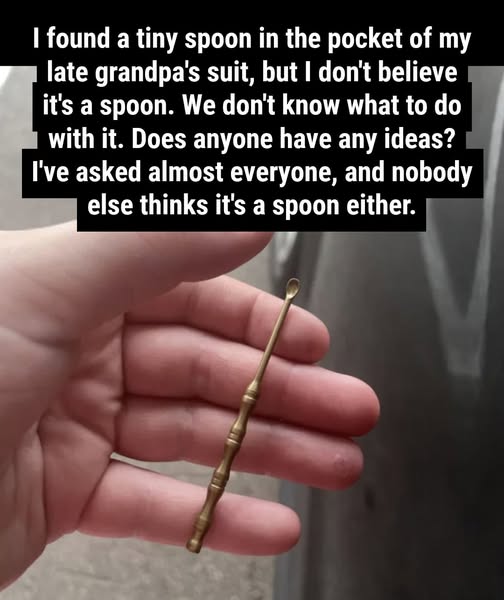
That’s exactly what happened when someone shared a photo of an unusually tiny metal spoon online. It wasn’t decorative or engraved. It didn’t match a known flatware set. It was much smaller than a teaspoon and didn’t resemble a standard measuring spoon.
It was simply… there.
And naturally, the internet had questions.
Thousands of people weighed in with guesses — some humorous, some historical, some surprisingly detailed. What followed wasn’t just speculation about a spoon. It was a fascinating display of collective curiosity.
Let’s explore the most plausible explanations — and why tiny objects like this capture our imagination so easily.
The Simple Question That Started It All
The original question was straightforward:
“What is this used for?”
The image showed a very small, plain metal spoon with a narrow handle and shallow bowl. It appeared older in style but not necessarily antique. It lacked branding or visible markings.
It didn’t clearly belong in a modern kitchen drawer.
And when an object lacks context, it instantly becomes intriguing.
Why Miniature Objects Feel So Mysterious
We understand spoons. They’re familiar tools. We use them daily for stirring coffee, scooping yogurt, serving sauces.
But shrink that spoon down to an unusual size, and suddenly the function becomes unclear.
Is it still meant for food?
Is it ceremonial?
Is it medical?
Is it decorative?
Is it obsolete?
When everyday objects don’t match modern expectations, they feel mysterious — even if they were once perfectly normal.
The Internet’s First Reaction: Playful Theories
Online communities rarely resist the opportunity for humor.
Among the early responses were imaginative suggestions:
-
A fairy-sized kitchen utensil
-
A prop from a fantasy set
-
A novelty stirrer for invisible potions
-
A collectible dollhouse accessory
While clearly playful, these responses reveal something important: when faced with uncertainty, people engage creatively. Humor is a way to participate in solving the mystery.
But beyond the jokes, more practical explanations began to surface.
Theory #1: A Historical Ear-Cleaning Tool
One of the most common suggestions in discussions about tiny spoons is that they may be ear-cleaning tools — sometimes called ear picks or ear scoops.
Historically, before modern disposable hygiene products became widespread, small reusable tools were used for personal grooming in various cultures. Some of these tools had spoon-like ends and slender handles.
Features that support this theory include:
-
Small size
-
Curved or shallow bowl
-
Metal construction
-
Simple design
Ear-cleaning tools have existed for centuries in different parts of the world, often crafted from metal, bone, or wood.
That said, modern health guidance strongly advises against inserting objects into the ear canal. Today, such historical tools are best viewed as collectibles rather than practical instruments.
Without clear context, it’s impossible to confirm whether this spoon falls into that category — but the resemblance keeps the theory alive.
Theory #2: A Nail-Cleaning Tool
Another plausible explanation is that the spoon was part of a grooming or manicure set.
Before disposable nail tools became common, reusable metal implements were widely used for personal care. Some included small scooped ends designed to clean beneath fingernails.
Characteristics that support this possibility:
-
Compact size
-
Slight curvature
-
Durable metal construction
-
Practical, non-decorative design
Antique grooming kits often contained multiple tools bundled together. Over time, these sets can become separated, leaving single pieces behind without context.
If the tiny spoon once belonged to such a set, it may simply have outlasted its companions.
Theory #3: A Salt Cellar or Spice Spoon
Historically, many dining tables featured salt cellars — small containers that held salt for individual use. These were often paired with tiny dedicated spoons.
In the 18th and 19th centuries especially, salt was stored and served differently than it is today. Small spoons were common for:
-
Salt
-
Mustard
-
Loose-leaf tea
-
Sugar
-
Ground spices
Unlike modern measuring spoons, these were not standardized by volume. They were designed specifically for transferring small amounts of seasoning.
If the tiny spoon once accompanied a matching container that has since been lost, it could easily appear mysterious on its own.
This explanation is both practical and historically grounded.
Theory #4: An Apothecary or Medicine Spoon
Before pre-measured capsules and tablets became standard, powdered remedies were often dispensed manually.
Pharmacists and apothecaries used small spoons to:
-
Measure powders
-
Transfer compounds
-
Mix medicinal ingredients
While many medicinal spoons were calibrated, others were simple transfer tools. Their small size allowed for careful handling of limited quantities.
If the spoon in question matches the proportions of historical apothecary tools, it could belong to that category.
However, without markings or documented provenance, this remains speculative.
Why Everyday Objects Lose Their Meaning
Many household items become “mysteries” for simple reasons:
-
They become separated from their original sets
-
Their use falls out of fashion
-
Technology replaces them
-
Packaging evolves
-
Cultural habits shift
What once felt ordinary can feel confusing decades later.
For example, butter paddles, glove stretchers, hat pins, and chatelaines were once common household items. Today, many people would struggle to identify them at first glance.
Context gives objects meaning. Remove the context, and curiosity fills the gap.
The Role of Collective Investigation
One of the most fascinating parts of these online mysteries is how collaborative they become.
When someone posts an unfamiliar object, responses often include:
-
Comparisons to museum artifacts
-
Personal family stories
-
Antique catalog references
-
Cultural insights
-
Professional expertise
People from different backgrounds contribute knowledge in areas like:
-
Culinary history
-
Antique collecting
-
Grooming traditions
-
Medical history
-
Cultural anthropology
What begins as a small question often turns into a shared learning experience.
Why the Grooming Theory Appears So Often
In many similar online discussions, tiny spoon-like objects are frequently identified as grooming tools.
That’s because historically:
-
Spoon-shaped ear tools were common
-
Nail cleaners often resembled miniature scoops
-
Compact personal care kits were widespread
It’s important to stress that identifying an object as a historical grooming tool does not mean encouraging its use today. Modern hygiene standards are very different, and antique tools should be appreciated as historical items rather than functional devices.
Still, their resemblance keeps this explanation popular.
The Emotional Appeal of Vintage Finds
Part of the fascination isn’t just about function — it’s about connection.
When people encounter unfamiliar old objects, they imagine:
-
Who once owned it
-
How it was used daily
-
What routines looked like in the past
-
How household habits have evolved
Objects carry traces of history, even when their stories are incomplete.
A small spoon may have once sat beside a teacup, rested in a sewing basket, or lived inside a travel grooming kit.
That unknown backstory invites imagination.
Why Definitive Identification Is So Hard
Properly identifying historical objects often requires:
-
Maker’s marks
-
Hallmarks or engravings
-
Material analysis
-
Documented origin
-
Period catalogs
Without those details, even experts may disagree.
Two items can look nearly identical while serving entirely different purposes.
That’s why online discussions often end with several “most likely” explanations rather than a single confirmed answer.
When Mystery Becomes the Point
Interestingly, sometimes solving the mystery isn’t the most rewarding part.
The value lies in:
-
The shared curiosity
-
The exchange of ideas
-
The discovery of forgotten tools
-
The learning process
Even if no one lands on a definitive answer, participants often walk away having learned something new.
And that’s meaningful.
Why Small Objects Go Viral
Tiny, puzzling objects capture attention because they’re relatable.
Unlike rare artifacts locked behind museum glass, small household items feel accessible. Anyone could find something similar in their home.
They spark imagination without requiring specialized knowledge.
All you need is curiosity.
A Practical and Responsible Note
If an object appears to resemble a historical grooming or medical tool, it’s best to treat it as a collectible or conversation piece rather than attempting to use it.
Health and safety standards have changed significantly over time.
Antique items are safest appreciated for their historical value.
What We Can Reasonably Conclude
Based on known historical comparisons, the tiny metal spoon most likely falls into one of three broad categories:
-
A grooming tool (such as an ear or nail cleaner)
-
A condiment or spice spoon
-
A small apothecary or measuring instrument
Each theory aligns with documented designs from different eras.
Without clear provenance, absolute certainty may remain out of reach.
But that uncertainty is part of the object’s appeal.
The Bigger Lesson About Curiosity
This tiny spoon reminds us that ordinary objects can spark extraordinary conversations.
In a world full of complex headlines and constant information, it’s refreshing when something simple captures collective attention.
A small, unexplained item in a drawer becomes a reminder that history is everywhere — often hiding in plain sight.
The next time you discover an unfamiliar trinket, don’t dismiss it too quickly.
Pause. Ask questions. Compare ideas. Explore possibilities.
You might not uncover a definitive answer.
But you’ll gain perspective, knowledge, and maybe even a deeper appreciation for the everyday objects that quietly shape our lives.
And sometimes, that journey of curiosity is more valuable than the answer itself.