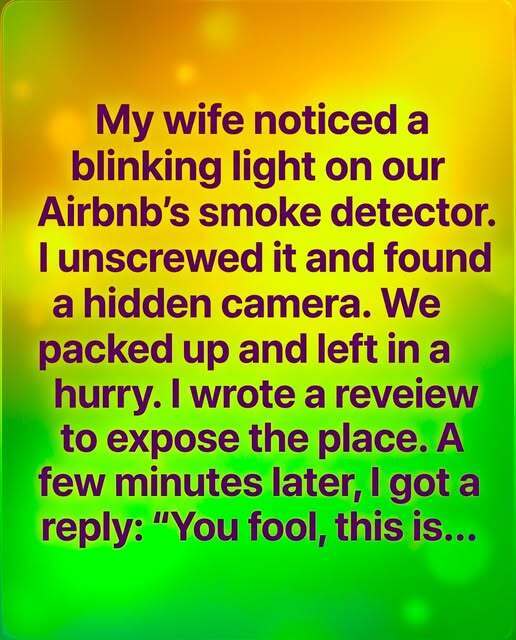
WE FOUND A HIDDEN CAMERA IN OUR AIRBNB BUT THE HOSTS CHILLING SEVEN WORD THREAT REVEALED WE WERE NEVER SUPPOSED TO ESCAPE THE RENTAL ALIVE
Hidden Camera in Our Vacation Rental: The Night We Realized We Were Being Watched
A weekend escape is supposed to feel simple: fresh air, quiet mornings, and the kind of privacy you can’t get in a busy city apartment. That’s exactly what my wife and I thought we were booking when we reserved a secluded cottage through a major vacation rental platform.
The listing looked ideal—warm lighting, a fireplace, big windows facing a wall of trees, and the promise of “total peace and privacy.” When we arrived, it delivered on the surface. The place smelled clean, the forest air was crisp, and everything seemed calm enough to finally exhale.
That calm lasted until the second night.
The Blinking Light Above the Bed
We were drifting off when my wife quietly sat up and pointed toward the ceiling. At first, I didn’t see it. Then my eyes adjusted: a faint, rhythmic blink coming from the smoke detector directly above our bed. It wasn’t bright—just a tiny, precise pulse that felt strangely mechanical in the dark.
But something about it didn’t sit right.
I pulled a chair over, climbed up, and looked closer. From the ground it appeared normal, but at an angle—through one of the plastic vents—I caught the unmistakable shine of glass.
A lens.
Not a sensor. Not a harmless LED.
A hidden camera.
From “Guests” to Targets in Seconds
The moment you realize your privacy has been violated, your brain changes gears. Your heart speeds up. Your thoughts narrow. You stop thinking about refunds and start thinking about exits.
I didn’t argue. I didn’t call customer support. I didn’t message the host.
I signaled to my wife, and we moved fast—quietly stuffing clothes into bags, leaving anything nonessential behind. Within minutes we were out the door and driving into the night, checking the rearview mirror like it was a reflex.
We didn’t stop until we reached a brightly lit 24-hour diner a couple of towns away—somewhere with cameras, people, and witnesses.
The Host’s Message That Turned Our Blood Cold
Shaking, I opened my phone and wrote a detailed review to warn other travelers. I expected the host to deny everything, maybe claim it was a “security device” or a misunderstanding.
Instead, the reply came quickly—and it wasn’t an apology.
The host accused us of damaging an expensive transmitter connected to a private security setup. Then, in a final line that didn’t read like customer service or a legal threat, they wrote:
“They will come looking for it.”
No explanation. No names. Just a warning that someone else would be involved.
What We Noticed in the Photos After We Fled
Trying to make sense of it, I started scrolling through the pictures I’d taken when we first arrived—normal shots of the living room, the windows, the fireplace. I zoomed in on one photo and noticed something I’d missed in real time.
Behind the heavy curtains was a small red dot—steady, bright, and positioned too deliberately to be a reflection. It looked like a laser marker, the kind used to indicate alignment or track movement.
That’s when the situation felt bigger than a single hidden camera.
It felt planned.
We Changed Our Plans Immediately
We didn’t go back. We didn’t “sleep on it.” We drove for hours until we reached a large chain hotel in a busy city—somewhere anonymous, staffed, and well-lit.
We checked in with minimal information, kept our bags close, and did what we could to reduce our digital footprint. It sounds dramatic until you’re living it—until you’ve read a message that implies someone is coming, and you don’t know who “they” are.
The next morning, we went straight to the police and filed a report. We provided photos of the smoke detector, the suspicious details we noticed, and screenshots of the host’s message.
The officer listened carefully and didn’t treat it like a joke. If anything, the response was sobering—like this wasn’t unheard of anymore.
The Real Cost of a Privacy Violation
Even after the report, even with a deadbolt and a hotel hallway outside our door, sleep didn’t come easily. Once you’ve had your sense of safety ripped away, you start seeing the world differently.
We trust strangers because a listing has five-star ratings. We assume a platform’s policies will protect us. We believe “private rental” means private.
But hidden surveillance turns that comfort into a trap. A blinking light isn’t always a safety feature. Sometimes it’s a signal that you’re being observed—recorded—studied.
The listing was eventually removed, and the host never contacted us again. But the mental aftermath stuck around. To this day, any unexpected blinking LED—on a smoke detector, a TV, a router—triggers that same jolt of unease.
How to Protect Yourself in a Vacation Rental
If you travel often, it’s worth taking privacy seriously. A few practical habits can make a difference:
- Inspect smoke detectors, alarm clocks, and vents—especially in bedrooms and bathrooms.
- Look for unusual LEDs or tiny pinhole openings facing beds or showers.
- Check the Wi-Fi network for unfamiliar devices (many routers show connected devices).
- Trust your instincts—if something feels off, leave and report it.
- Document everything with photos and screenshots before confronting anyone.
Final Thoughts
We booked a quiet cabin expecting rest. What we found was a reminder that privacy isn’t guaranteed just because a place looks “cozy” online. Technology has made travel easier—but it’s also made it easier for bad actors to hide in plain sight.