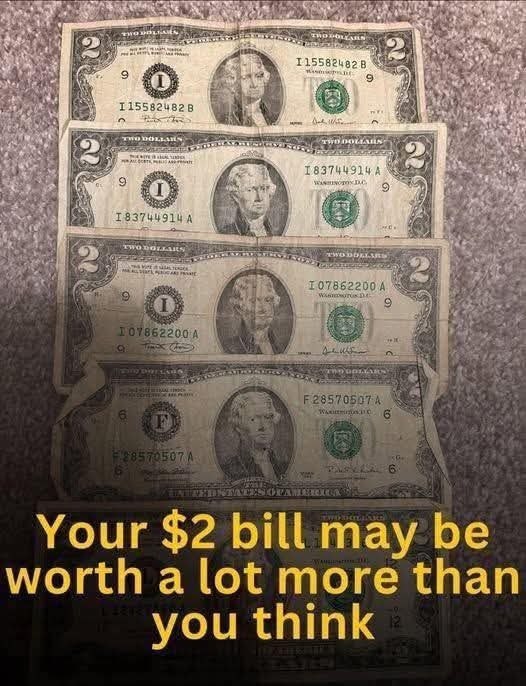
Why Some $2 Bills Could Be Worth More Than Their Face Value
For most people in the United States, paper money is simply part of daily life. Bills pass quickly from hand to hand at grocery stores, restaurants, and retail shops without much thought. However, certain pieces of currency can attract attention from collectors and historians because of their unique characteristics or historical importance.
One interesting example is the $2 bill. Although it remains legal tender in the United States, this denomination is rarely seen in everyday transactions. Because of this, many people assume it is uncommon or even discontinued. In reality, the $2 bill is still printed periodically, and millions of them exist.
What makes the denomination fascinating is that some $2 bills may hold additional value beyond the amount printed on them, particularly when they possess specific traits that collectors look for. Understanding why requires exploring the history of the bill, the features that attract collectors, and the cultural myths that surround it.
For anyone interested in rare currency, historical banknotes, or simply curious about the money in their wallet, the $2 bill offers a surprisingly rich story.
The History Behind the $2 Bill
The origins of the $2 bill date back to the mid-19th century, when the United States government expanded paper currency during the Civil War era.
The first version of the bill appeared in 1862, during a time when the federal government was issuing paper money to help finance wartime expenses. These early banknotes looked very different from the bills used today.
Over time, the design and size of U.S. paper currency changed significantly. Early versions were larger and featured detailed engravings that reflected the artistic style of the era.
Eventually, the design evolved into the smaller format that Americans recognize today.
Design Changes Over the Years
Throughout its history, the $2 bill has undergone several redesigns. Each version reflects different periods in American history.
Some of the key design stages include:
1862–1918: Large-size banknotes
These early notes were physically larger than modern currency and often included elaborate portraits and decorative patterns.
1928–1963: Small-size red-seal notes
In 1928, the U.S. Treasury standardized the size of all paper currency. The $2 bill was redesigned with a smaller format and a red Treasury seal.
1976 Bicentennial redesign
A major redesign occurred in 1976 to celebrate the 200th anniversary of American independence. The reverse side of the bill features a depiction of the signing of the Declaration of Independence based on a famous painting by John Trumbull.
This design remains in use today and is one of the most recognizable elements of the modern $2 bill.
Why the $2 Bill Feels Rare
Even though millions of $2 bills have been printed, many Americans rarely encounter them in everyday life.
This situation has created a widespread belief that the denomination is rare or no longer produced. In reality, the bill remains part of the U.S. currency system.
The main reason it seems unusual is low circulation.
Because people often save $2 bills instead of spending them, fewer remain in active use. This behavior creates a cycle:
-
People rarely see the bill
-
They assume it is uncommon
-
They keep it as a curiosity
-
Circulation decreases even further
Over time, this pattern has given the $2 bill an almost legendary status among casual observers.
Cultural Significance of the $2 Bill
Beyond its monetary value, the $2 bill also holds cultural and historical importance.
The portrait on the front features Thomas Jefferson, the third President of the United States and one of the key figures behind the nation’s founding documents.
The reverse side shows the signing of the Declaration of Independence, one of the most important events in American history.
For collectors and historians, these details make the bill more than just currency—it becomes a symbol of the country’s early political history.
Characteristics That Can Increase Value
Although most $2 bills are worth exactly two dollars, some examples attract interest from collectors because of specific features.
Several factors can influence the value of collectible banknotes.
Series Year
One of the first things collectors check is the series year printed on the bill.
Older series can sometimes be more desirable because fewer examples remain in good condition.
Examples include:
-
Early large-size notes from the late 1800s
-
Red-seal notes printed between 1928 and 1963
-
Bicentennial series notes from 1976
Older notes may have historical appeal, especially if they remain well preserved.
Treasury Seal Color
Another identifying feature is the color of the Treasury seal printed on the bill.
Common seal types include:
Green seals
Modern Federal Reserve notes typically use a green seal.
Red seals
Older U.S. Notes often feature a red seal and may attract collector interest.
Brown seals
Some historical banknotes issued by specific banks used brown seals.
Collectors sometimes prefer red-seal notes because they represent an earlier era of American currency.
Serial Numbers
Serial numbers are among the most exciting elements for currency collectors.
Certain patterns are considered unusual or visually appealing, which can increase interest among buyers.
Examples of notable serial numbers include:
-
Very low numbers (such as 00000025)
-
Repeating digits (like 77777777)
-
Sequential patterns (12345678)
-
Palindrome or “radar” numbers (12344321)
-
Solid numbers where every digit is the same
Because these patterns are uncommon, collectors often pay premiums for them.
Printing Errors
Occasionally, printing mistakes occur during the production process. These errors can create unique variations that collectors find interesting.
Possible printing errors include:
-
Misaligned printing
-
Ink smudges
-
Double prints
-
Missing elements in the design
While such errors are rare, they can significantly increase the value of a bill depending on the severity and uniqueness of the mistake.
The Importance of Condition
Just like coins, stamps, or other collectibles, condition plays a major role in determining the value of paper currency.
Collectors use grading systems to describe how well a bill has been preserved.
Common grading categories include:
Good or Poor – heavily worn with significant creases
Fine – moderate wear but still clearly readable
Very Fine – minor wear with relatively crisp appearance
Extremely Fine – very light signs of circulation
Uncirculated – crisp and clean with no folds
A rare serial number or older note in excellent condition is usually far more desirable than the same bill with heavy wear.
Why Businesses Rarely Use $2 Bills
Although the $2 bill is legal tender, many businesses rarely see them.
There are several practical reasons for this.
First, most cash registers are designed with compartments for the most common denominations such as $1, $5, $10, and $20 bills. Since $2 bills appear infrequently, many businesses simply do not allocate space for them.
Second, employees who rarely encounter the bill may hesitate when accepting it. Some people mistakenly believe the denomination is no longer valid.
Finally, consumer habits play an important role. Because people often keep $2 bills as keepsakes, fewer of them circulate in normal transactions.
The Collectible Currency Market
Currency collecting, often referred to as numismatics, is a popular hobby that attracts enthusiasts from around the world.
Collectors often seek:
-
Historic banknotes
-
Rare serial numbers
-
Limited print runs
-
Unique printing variations
Auction houses, specialized dealers, and online marketplaces provide platforms where collectors can buy and sell rare banknotes.
Some historic U.S. notes have sold for thousands of dollars, particularly when they are rare, well preserved, and historically significant.
However, it is important to remember that most modern $2 bills remain common and do not carry large premiums.
Myths and Superstitions
Over the years, the $2 bill has also become associated with several cultural myths.
Some people once believed the bill brought bad luck. Others associated it with gambling because it was sometimes used for betting or tipping in casinos.
Historians suggest these beliefs likely developed simply because the bill was unusual. When people encounter something unfamiliar, they often create stories or traditions around it.
Today, these myths remain part of the bill’s cultural folklore but have no factual basis.
How to Check Your Own $2 Bills
If you happen to find a $2 bill in your wallet, drawer, or old collection, it may be worth taking a closer look.
Here are a few simple steps:
-
Check the series year printed on the bill
-
Look at the color of the Treasury seal
-
Examine the serial number for unusual patterns
-
Inspect the overall condition of the note
While most bills will still be worth two dollars, a small percentage may interest collectors.
Storing Collectible Currency
If you believe a banknote might have collectible value, proper storage can help protect it.
Experts recommend:
-
Using protective plastic sleeves
-
Avoiding folding or bending the note
-
Keeping it in a cool, dry location
-
Handling it as little as possible
Preserving the condition of a note is one of the most important factors in maintaining its potential value.
When to Seek Professional Advice
For rare or unusual banknotes, professional evaluation may be helpful.
Experienced currency dealers or grading services can examine a note and determine its authenticity, rarity, and condition.
Professional grading often increases buyer confidence if the owner eventually decides to sell the bill.
The Future of Paper Currency
As digital payments continue to grow, many financial transactions now occur without physical cash.
Credit cards, mobile payment apps, and online banking have reduced the role of paper money in everyday purchases.
Ironically, this shift may increase interest in collectible banknotes. As physical currency becomes less common in daily life, historic notes may gain additional attention from collectors and historians.
Final Thoughts
The $2 bill remains one of the most intriguing pieces of American currency. While it is still legal tender and widely printed, its limited circulation has given it a reputation for rarity and mystery.
For collectors, certain versions—especially older notes, unusual serial numbers, or printing errors—can carry additional value.
For everyone else, the story of the $2 bill serves as a reminder that even ordinary objects can hold interesting history and unexpected surprises.
The next time you receive a $2 bill, it might be worth pausing for a moment to examine it. In most cases it will simply be worth two dollars, but occasionally a small detail could make it far more interesting to collectors.