Why the 1972 Oscars remains one of the the best ever
Why the 1972 Oscars Still Feels Like the Gold Standard of the Academy Awards
The Oscars have always been a mirror of Hollywood—but the 1972 Academy Awards (the 44th ceremony) feels like a rare snapshot of the industry at a turning point. It wasn’t just a night of trophies. It was a full-scale celebration of film history, where classic Hollywood elegance met the bold, risk-taking spirit of a new generation of filmmakers.
Today, plenty of viewers feel modern award shows can lean more toward spectacle than sincere appreciation. But when you revisit 1972, what stands out is the tone: real excitement, real emotion, and real respect for the craft. The atmosphere wasn’t polished into blandness—it was alive.
A Best Picture Lineup That Still Looks Legendary
One reason the 1972 Oscars remains so memorable is simple: the movies were extraordinary. The nominees reflected an era when mainstream cinema was willing to be challenging, gritty, and artistically ambitious.
The French Connection led the night, winning five Oscars including Best Picture, Best Director (William Friedkin), and Best Actor for Gene Hackman. The film’s street-level realism and nerve-jangling chase sequences didn’t just entertain—they changed what audiences expected from crime thrillers.
Hackman later described how demanding the production was, and that intensity showed on screen. His win also delivered one of the night’s most human moments—he seemed genuinely stunned, the kind of reaction that reminds you these awards once felt less rehearsed and more heartfelt.
And it wasn’t a one-film year. The ceremony also honored films that still spark discussion today:
- A Clockwork Orange, Stanley Kubrick’s provocative, dystopian masterpiece—controversial then, influential forever.
- Fiddler on the Roof, a sweeping musical that proved the genre could still feel grand and emotionally grounded.
- The Last Picture Show, Peter Bogdanovich’s haunting coming-of-age drama, shot in striking black-and-white and packed with subtle, character-driven storytelling.
The Last Picture Show earned eight nominations, with Cloris Leachman and Ben Johnson winning supporting acting Oscars—performances that still feel honest, textured, and timeless.
Old Hollywood Glamour—Without Feeling Like a Costume
Visually, the 1972 Oscars looked like Hollywood remembering how to be Hollywood. The red carpet leaned into classic elegance: flowing gowns, luxe fabrics, diamonds, and formal tailoring. The louder fashion trends of the era faded into the background, replaced by silhouettes that felt closer to the golden age than the counterculture.
There were still statements, of course—Jane Fonda stood out in a sleek pantsuit—but overall the night delivered a kind of timeless award-show style that people still reference when talking about “peak Oscar glamour.”
The Night Had Energy Outside the Theater, Too
Like much of early-1970s America, the mood wasn’t all champagne and spotlights. Crowds gathered outside the Los Angeles Music Center hoping to glimpse stars, while protests nearby reflected the era’s political and cultural friction.
One major target that year was Dirty Harry. Even though it wasn’t nominated, it drew criticism from demonstrators who argued it glamorized police violence. The contrast—high fashion and high tension—made the night feel like a true cultural moment, not just a TV production.
Isaac Hayes Changed Oscar History
Music helped define the ceremony, and no performance is remembered more vividly than Isaac Hayes winning Best Original Song for “Theme from Shaft”. He became the first Black winner in that category, and his performance brought a new sound and presence to the Oscar stage—confident, bold, and undeniably of the moment.
It wasn’t just a musical number; it felt like the Academy acknowledging that film culture was expanding—and that the Oscars had to expand with it.
Betty Grable’s Bittersweet Spotlight
The ceremony also carried a sense of farewell. Screen legend Betty Grable appeared in one of her final public moments, reminding audiences of an earlier Hollywood era when movie stars were mythic figures.
Grable wasn’t only famous—she was a genuine box-office force, a defining face of American entertainment, and a symbol of wartime Hollywood. Her presence added emotional weight to the evening, especially knowing she would pass away the following year.
Charlie Chaplin’s Return: The Most Emotional Moment of the Night
If the 1972 Oscars had one scene that felt bigger than the ceremony itself, it was Charlie Chaplin stepping onto the stage.
Chaplin—one of cinema’s foundational artists—had been pushed out of the U.S. decades earlier amid accusations tied to political sympathies. His surprise appearance was more than nostalgia. It was recognition, reconciliation, and history happening in real time.
The crowd delivered a 12-minute standing ovation, still the longest in Oscar history. Chaplin, visibly moved, thanked the Academy with a humility that made the moment unforgettable for everyone watching—inside the theater and at home.
A Perfect Blend of Hollywood Icons and Rising Stars
What truly made the 1972 Academy Awards special was the mix: established legends sharing space with the faces of a changing industry. The room included names like Jane Russell alongside a new wave—Jack Nicholson, Gene Hackman, Cloris Leachman, Jane Fonda, and Raquel Welch.
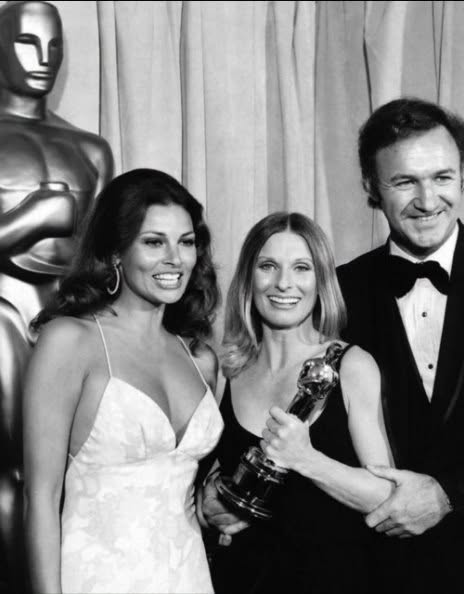
That blend is why photos from the night still feel electric. One image that captures the era perfectly is the trio of Hackman, Leachman, and Welch—three careers representing three different lanes of Hollywood’s evolution: prestige acting, character-driven storytelling, and star-powered cultural influence.
In one frame, you can see what the early ’70s really were for film: a bridge between tradition and experimentation, between studio polish and raw realism.
Why It Still Matters
The 1972 Oscars endures because it felt like the Academy Awards at its best: great films, genuine reactions, cultural relevance, and unforgettable star power. It wasn’t perfect—but it was alive, and it honored cinema in a way that still resonates.
That’s why, decades later, people don’t just remember who won—they remember how it felt.
What do you think—was 1972 the greatest Oscars year ever, or is there another ceremony you’d rank above it? Share your pick in the comments and tell us which Oscar moment still gives you chills.