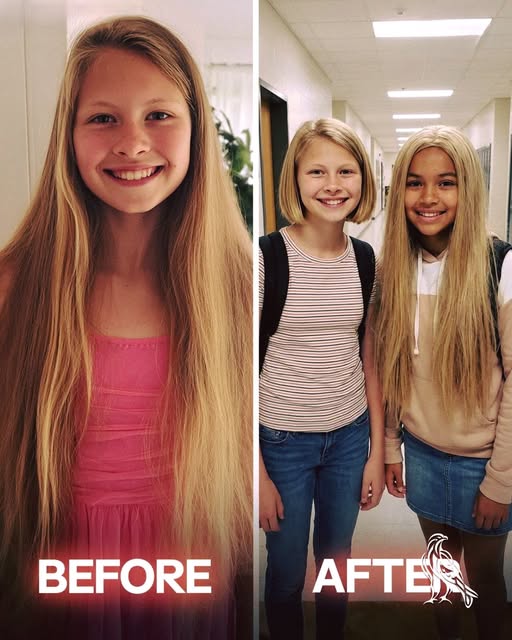
After my daughter cut her hair for a child battling cancer, I was called to the school for something unexpected
My Daughter Donated Her Hair to a Child With Cancer—Then the School Called Me In for a Surprise I Never Saw Coming
The phone rang while I stood at the kitchen sink, rinsing out Letty’s cereal bowl and trying not to look at the small hook by the door—the one where Jonathan’s keys used to hang. Three months later, that empty space still felt louder than anything in the house.
I answered with wet hands and a tired heart.
The principal spoke carefully, the way people do when they’re trying not to set off an explosion. I didn’t wait for him to explain. I asked the only question that matters when you’re a parent living with constant worry:
“Is Letty okay?”
He said yes—too quickly, too smoothly—like he’d practiced it. Then came the part that made my stomach drop.
“There are six men here asking for your daughter… by name.”
My grip slipped. The bowl knocked against the sink and cracked. For a second, I couldn’t tell if the sound came from the porcelain or from inside me.
The principal added that Letty had refused to leave the office when she heard her father’s name mentioned. That detail hit hardest of all. Jonathan wasn’t just “gone” to her. He was still a living presence in the way she reacted, the way grief had settled into her like a second skeleton.
I grabbed my coat and left without even thinking. Whatever was happening at school, I knew it wasn’t random. It was tied to something I didn’t understand yet.
The Night Before: A Ribbon of Hair and a Decision Too Big for a Child
The truth is, the day had already started unraveling long before that call.
The night before, I found Letty in the bathroom holding a ribboned bundle of hair—her hair—cut off with kitchen scissors. Her hands were trembling, but her eyes were steady. Not defiant. Not reckless. Just… determined.
She told me about a girl at school going through cancer treatment, how the girl’s hair had been falling out, how whispers and awkward laughter followed her down the hallway until she stopped looking up at anyone.
Letty said the girl had cried in the bathroom where no one could see.
And then my daughter—nine years old, still small enough to climb into my lap—made a choice that felt far older than her years.
“If she has to lose hers,” Letty said quietly, “maybe she shouldn’t have to feel like she’s losing everything.”
She didn’t call it a “good deed.” She didn’t wait for permission. To her, it was simple logic: if someone feels alone, you don’t stand there and watch. You do something.
That was Jonathan in her voice.
That was the man who used to believe kindness wasn’t a personality trait—it was a responsibility.
I hugged her before I could talk myself out of it. Because in that moment, I understood something both heartbreaking and beautiful:
She hadn’t lost her father completely. She had inherited him.
A Salon Visit, a Fresh Cut, and a Quiet Shift in the Air
The next morning, we went to Teresa’s salon to fix what emotion and scissors had started. Letty sat under the cape like she was stepping into a new version of herself. Teresa shook her head and muttered about children and “brave little impulses,” but her hands were gentle.
Halfway through, Luis walked in, spotted the cut hair on the counter, and froze.
Then he said Jonathan’s name.
The room changed instantly—like the air recognized it.
They talked about him in pieces: extra shifts he took without complaining, jokes he told when everyone was exhausted, small acts of generosity nobody fully noticed until he wasn’t around to do them anymore.
Letty listened like she was collecting proof. Like she was rebuilding her father from scattered memories.
By the time the wig was being arranged, I realized this wasn’t only about hair.
It was about dignity.
It was about a child choosing compassion in a world that often rewards people for looking away.
The Principal’s Office: A Wig, a Mother Crying, and Something Familiar on the Desk
When I arrived at school, I expected trouble—rules broken, a lecture, maybe an uncomfortable conversation about “proper procedures.”
Instead, I walked into the principal’s office and saw Letty standing beside a girl I barely recognized at first.
Then I saw why.
The wig.
The girl looked different—not just on the outside. She looked like she could breathe again. Like she wasn’t being stared at anymore, but finally seen as herself.
Her mother was quietly crying, one hand pressed to her mouth as if she couldn’t trust her voice.
And Letty stood next to them like she belonged there, calm and certain, as if kindness was the most normal thing in the world.
Then my eyes dropped to the desk.
Jonathan’s old hard hat.
His name was still written inside it.
Seeing it opened something in me I thought I’d already sealed shut. The principal tried to explain, but my brain couldn’t catch up. Not with that piece of my husband sitting in the center of the room like it had never left.
Letty turned toward me slowly, her face full of questions she didn’t yet have words for.
The Six Men and the Envelope With Jonathan’s Handwriting
That’s when the six men stepped forward—the same six the principal had mentioned on the phone.
They weren’t loud. They didn’t need to be. They carried the quiet weight of people who had shared long shifts, hard days, and the kind of bond that forms when you work side-by-side for years.
One of them placed an envelope on the desk.
My throat tightened the second I saw it.
Jonathan’s handwriting.
The room went still.
Marcus—Jonathan’s old supervisor—cleared his throat and finally explained why they were there.
Jonathan had been building something long before any of us knew. Not a big public program. Not a flashy charity with banners and speeches.
A quiet medical expense relief fund—money set aside to help families drowning under hospital bills, treatment costs, and the kind of financial stress that can break a household even when love is strong.
It wasn’t official. It wasn’t polished.
It was personal.
It lived in the space between paychecks. In the moments when someone mentioned a sick child or a spouse in surgery, and Jonathan would simply say, “We’ll figure it out.”
And somehow—through time, grief, and the strange way life circles back—his fund had found its way to my daughter’s school on the very day Letty gave a piece of herself to help another child feel whole again.
Letty looked from the men to the envelope, trying to understand how her dad could still be changing lives when he wasn’t here to see it.
And I realized something I’d been too broken to see clearly:
Grief isn’t only about what’s missing. It’s also about what continues.
In that office, surrounded by people who weren’t really strangers at all, I finally understood what Jonathan had always known better than I did—
Love doesn’t disappear. It moves.
Closing Thought
If this story moved you, share it with someone who needs a reminder that small acts of kindness matter more than we realize. And if you’ve ever seen compassion show up in an unexpected way, tell us in the comments—your story might be exactly what another reader needs today.